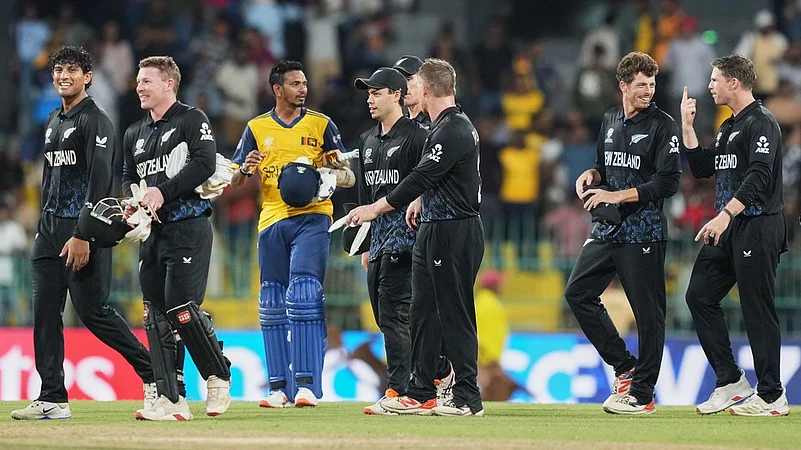
The ICC Men’s T20 World Cup 2026 has witnessed its first major casualty from the host nations. In a high-stakes Super Eight encounter at the R. Premadasa Stadium in Colombo, New Zealand delivered a clinical performance to defeat Sri Lanka by 61 runs, effectively ending the co-hosts' journey in the tournament. On a night where the pitch whispered secrets to the spinners, it was the Black Caps who listened more intently, turning a mid-innings crisis into a position of absolute dominance.
For Sri Lanka, the exit is a bitter pill to swallow. Playing in front of a packed, passionate home crowd, the expectations were sky-high for the 2014 champions. However, a familiar frailty in their batting lineup against elite spin bowling surfaced at the worst possible moment. For New Zealand, this victory is more than just two points; it is a declaration of intent as they edge closer to a semi-final berth, relying on their trademark resilience and tactical flexibility.
Match Context: A Battle for Survival
Entering this clash, both teams were aware that the margin for error had vanished. Sri Lanka had already suffered a heavy defeat at the hands of England, leaving them desperate for a win to keep their semi-final hopes alive. New Zealand, having seen their previous fixture against Pakistan washed out, sat on a solitary point and needed a result to avoid falling behind the pack in Group 2.
The R. Premadasa surface was a classic Colombo "turner"—dry, abrasive, and offering significant grip from the outset. When Sri Lanka won the toss and chose to bowl, it seemed like a masterstroke. The New Zealand middle order, usually so stable, found themselves tangled in a web spun by Maheesh Theekshana and Dushmantha Chameera.
The Turning Point: The Santner-McConchie Rescue Act
At 84 for 6 in the 13th over, New Zealand were staring at a sub-120 total. Theekshana’s carrom balls were proving unplayable, and the home crowd was in a frenzy. However, cricket is a game of shifting momentums. What followed was a record-breaking 84-run partnership for the seventh wicket between captain Mitchell Santner and the recalled Cole McConchie.
The duo didn't just survive; they counter-attacked. Santner, often criticized for his strike rate in the middle overs, played a captain’s knock, smashing 47 off 26 balls, including four towering sixes. McConchie provided the perfect foil, remaining unbeaten on 31 off 23. The final four overs were a carnage that saw New Zealand plunder 70 runs, propelling them to a formidable 168 for 7. This late surge completely deflated the Sri Lankan camp and changed the psychological complexion of the match.
Key Talking Points: Tactical Masterclass vs. Batting Meltdown
Several tactical decisions defined the outcome of this contest:
- The Powerplay Strangle: While spin dominated the headlines, Matt Henry set the tone with the new ball. His opening spell (2-1-3-2) was a masterclass in seam movement. Dismissing the prolific Pathum Nissanka for a golden duck on the very first ball of the chase essentially broke the back of the Sri Lankan pursuit before it began.
- The Spin Trap: Mitchell Santner used his resources perfectly. Knowing the pitch offered bounce, he encouraged Rachin Ravindra to toss the ball up. Ravindra responded with career-best figures of 4 for 27, consistently beating the Sri Lankan batters in flight and dip.
- The Death Over Failure: Sri Lanka’s inability to close out the New Zealand innings was the primary reason for their defeat. After having the Kiwis 6 down, allowing 168 was a massive tactical failure by the bowlers and the captaincy of Dasun Shanaka.
Player Focus: Rachin Ravindra’s All-Round Brilliance
While Santner provided the fireworks, Rachin Ravindra provided the stability and the clinical finish. After contributing a quick 32 with the bat, Ravindra dismantled the Sri Lankan middle order. His dismissal of Kusal Mendis—a beautiful piece of drift that drew the batter forward into a stumping—was the highlight of the evening.
"We knew 160 was a winning total on this deck. Once the boys (Santner and McConchie) got us there, my job was just to hit the right areas and let the pitch do the rest," Ravindra remarked during the post-match presentation.
His ability to operate as a front-line spinner in Asian conditions has given New Zealand a massive tactical edge, allowing them to balance their side with extra batting depth.
Tournament Impact: The Race to the Semis
- Sri Lanka Eliminated: With two losses in two games, the co-hosts are officially out. Their final game against Pakistan is now merely a matter of pride.
- New Zealand’s Path: The Black Caps move to 3 points. A win in their final game against England will guarantee them a spot in the semi-finals. Even a narrow loss might see them through, thanks to a massive boost in their Net Run Rate (+3.050).
- Pakistan’s Dilemma: This result is a nightmare for Pakistan. They now not only need to beat Sri Lanka by a huge margin but also pray that England defeats New Zealand by enough of a margin to tank the Kiwis' NRR.
Broader Perspective: The End of an Era for Sri Lanka?
Sri Lanka’s exit on home soil will likely lead to some soul-searching. Since their 2014 triumph, they have struggled to find consistency in the T20 format. The inability of their batters to rotate strike against spin and the lack of a "finisher" in the mold of a Perera or Jayawardene has left them exposed against top-tier opposition.
New Zealand, conversely, continue to be the "tournament specialists." Despite losing key wickets in the middle, their lower-order depth and disciplined bowling units ensure they are always in the hunt. They have now made the knockout stages or stayed in contention until the final day in every ICC event for the last decade.
What’s Next?
New Zealand face a powerhouse England side on Friday at the same venue. It will be a battle between England’s raw aggression and New Zealand’s calculated restraint. For the Black Caps, the objective is simple: win and qualify.
Sri Lanka travels to Pallekele to face Pakistan. While they are out of the tournament, they hold the keys to Pakistan’s fate. If the Lankans can pull off a victory, they will take Pakistan down with them, a prospect that might offer some small consolation to their grieving fans.
Conclusion
The 2026 T20 World Cup has lost a host, but it has gained a New Zealand team that looks increasingly dangerous. Their 61-run victory over Sri Lanka was a display of mental toughness and tactical superiority. As the tournament moves into its final stages, the "Black Caps" have once again proven that you can never count them out. For Sri Lanka, the "home-team blues" are real, and the road to rebuilding will be long and arduous.